
5 Tire Safety Tips to Keep Your Summer Road Trip on Track
Summer is road trip season — families loading up the minivan, friends heading out for long weekends, and drivers finally taking the trips they’ve planned for years. But it’s also the most dangerous time of year for your tires.
Safety experts refer to May through October as “blowout season” because high pavement temperatures, heavy vehicle loads, and long highway drives put added stress on tires. According to the National Highway Traffic Safety Administration, nearly 11,000 tire-related crashes occur in the U.S. each year, resulting in about 600 deaths — most of them preventable. The good news? A quick 10-minute check before you hit the road can dramatically reduce your risk.
1. Check Your Tire Pressure, and Know Where to Find the Right Number
This is the single most impactful thing you can do. Yet only 19% of consumers properly inflate their tires, according to NHTSA’s TireWise campaign. Underinflation doesn’t just waste fuel, it’s dangerous. Vehicles with tires underinflated by more than 25% are three times more likely to be involved in a tire-related crash.
The most common mistake? Looking at the tire sidewall for the PSI number. That number is the tire’s maximum pressure, not what your vehicle requires. Your correct tire pressure is usually on the driver’s side door jamb or in your owner’s manual.
Check pressure when your tires are “cold”, meaning the car hasn’t been driven for at least three hours. And don’t forget: tires naturally lose 1–2 PSI per month through normal air permeation. Before any long trip, check all four tires, and don’t forget the spare.
2. Understand the Heat Effect
Here’s something most drivers don’t realize: tire pressure isn’t a fixed number. It changes with temperature.
For every 10°F rise in temperature, tire pressure goes up by 1–2 PSI. On a hot summer day, asphalt surface temperatures can reach 150°F. That means a tire you checked at 32 PSI on a cool morning could be running at 36 PSI by early afternoon. Overinflated tires have less contact with the road, which can reduce traction and increase the risk of a blowout, especially during highway driving.
The practical advice: check pressure in the morning before driving, and re-check before you get back on the road after a lunch stop on a long trip. Never bleed air from a warm tire to adjust pressure, wait for it to cool first, or you’ll end up underinflated once temperatures drop.
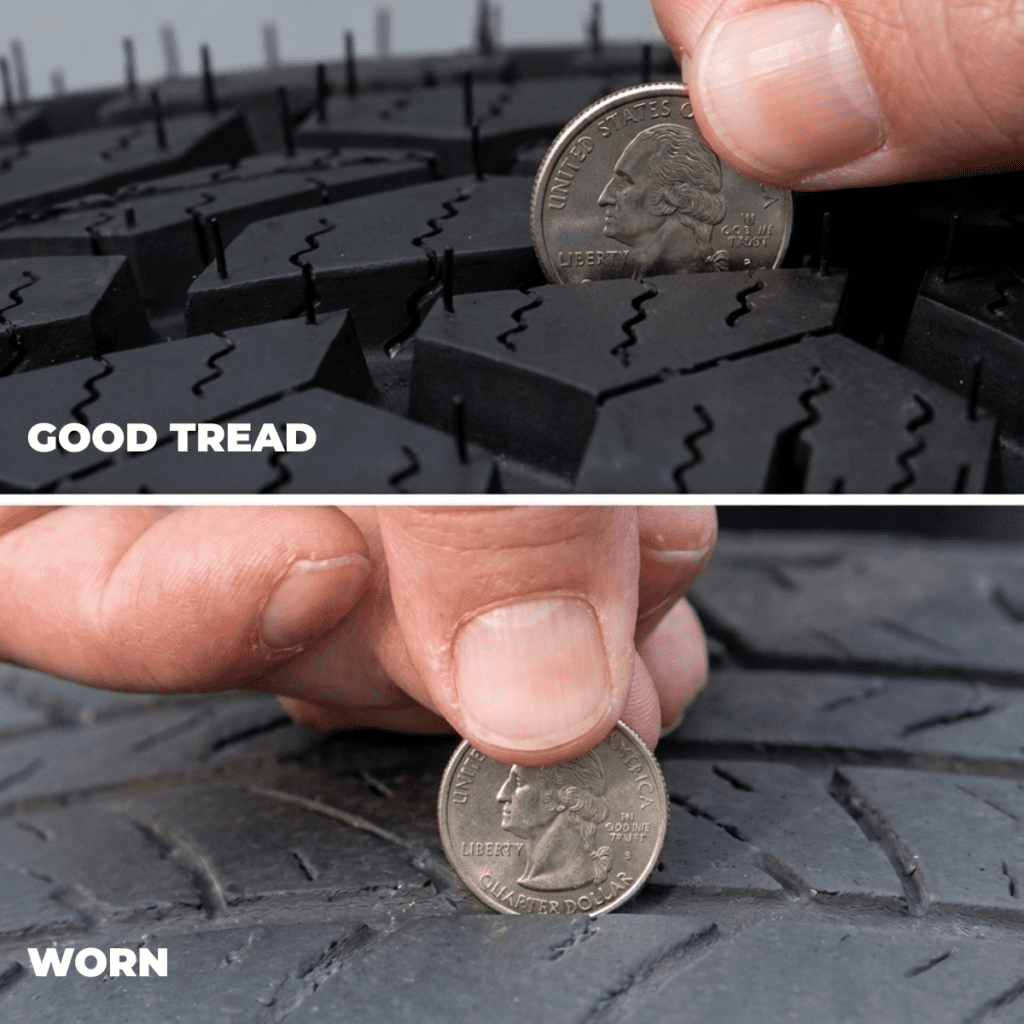
3. Do the Quarter Test, Your Tread Tells the Real Story
Tire tread is what keeps your vehicle connected to the road when it rains, when you brake suddenly, or when you have to swerve around something unexpected. AAA testing found that driving on worn tires in wet conditions increases average stopping distance by 43%, or an additional 87 feet compared to new tires at highway speeds.
Here’s the quick test: take a quarter, insert it head-down into your tire tread groove, and look at Washington’s head. If you can see the top of his head, your tread is below 4/32 of an inch, that’s your sign to start shopping for new tires. And check a few spots on each one, because uneven wear can hide along the edges.
4. Check Your DOT Date Code, Tires Age Even Sitting Still
This is the tip most drivers have never heard: tires have a birthdate, and age matters even when tread looks fine.
Find the DOT code on your tire sidewall, it’s a series of letters and numbers that ends with four digits, indicating the week and year of manufacture. A code ending in “2620” means the tire was made in week 26 of 2020. Rubber degrades over time from heat, UV exposure, and oxygen, even if a tire has never been driven hard.
If your tires are approaching six years, have them inspected by a professional before your summer trip. And always check the spare, it’s the most commonly overlooked aging risk on any vehicle.
5. Do a Quick Visual Inspection, Some Damage Is Obvious
Before every long drive, walk around your vehicle and take 60 seconds to look at each tire. You’re checking for:
- Sidewall cracks or bubbles: a bubble is a stop-driving-immediately situation. It means the internal structure has failed and a blowout is imminent.
- Embedded objects: nails, screws, and road debris often embed without immediately deflating a tire. Better to find it before you’re on the highway.
- Uneven wear patterns: center wear indicates consistent over-inflation; edge wear indicates consistent underinflation; cupping or scalloping suggests suspension issues.
No tools needed. Just your eyes.
Before You Pull Out of the Driveway
These five checks take about 10 minutes and require no mechanical expertise — just a reliable tire gauge and a well-lit parking spot. Make them part of your routine before every long trip. Tires don’t care whether you’re driving 10 miles or 1,000.
And don’t rely solely on your TPMS (Tire Pressure Monitoring System) warning light. It typically activates only after a tire is already significantly underinflated — often 25% below the recommended pressure. By then, the risk is already elevated. These five simple habits can help you stay safer on the road all summer long.