
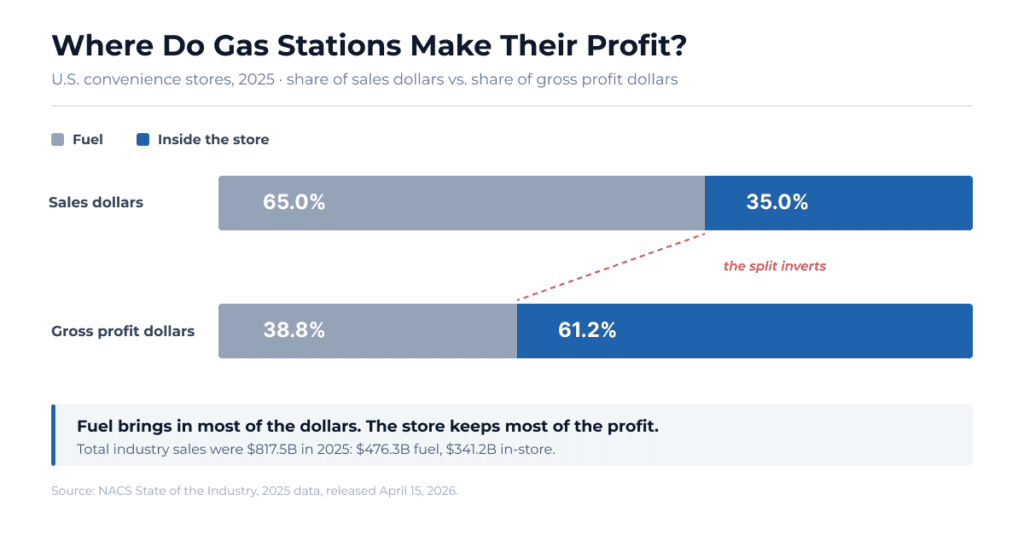
Fuel accounts for roughly two-thirds of gas station and convenience store sales—but barely a third of the profit. Understanding that difference is key to understanding gas station profit margins and where operators have the greatest opportunity to improve profitability.
According to the National Association of Convenience Stores (NACS) data released in 2026, the U.S. convenience store industry generated approximately $817.5 billion in sales in 2025. Fuel accounted for $476.6 billion of that total, while in-store sales generated $341.2 billion.
Where Do Gas Stations Make Their Profit?
Fuel moves the volume and attracts customers, the store moves the margin.
At first glance, it seems obvious: the profit comes from inside the store, so inside is where you sell. But, there’s a problem becoming more evident for operators: the average c-store transaction is becoming more expensive to generate.
Which raises the question every gas station and c-store operator should be asking: how do I turn every visit into a more valuable customer interaction – one that produces a sale today and a reason to come back tomorrow?
The data is clear: while fuel may be what first brings a customer to your location, in-store purchases are what drive the business and play a major role in overall gas station profit margins. That makes your forecourt more than just a place to fuel—it’s your first opportunity to make an impression. The experience customers have outside influences whether they simply fill up and leave or take the next step and walk into your store.
What Is the Average Gas Station Profit Margin?
There isn’t one number – and any source that gives you a single percentage is merging two different businesses and treating it as one.
On fuel, the margin is thin and mostly gets spent before it reaches you. NACS reports the average markup on a gallon of gas is about 35 to 40¢, and after expenses a retailer keeps roughly a third of that – with a net of 10 to 15¢ per gallon before taxes.
Inside the store, gross margins are several times higher – which is exactly why 35% of sales dollars produce 61.2% of gross profit. Foodservice illustrates the point: it made up to 28.5% of in-store sales in 2025 but delivered 38.9% of in-store gross profit dollars.
But gross margin isn’t take-home margin. Direct store operating expenses – wages, benefits, card fees, utilities and maintenance – rose 4.2% in 2025, and card fees hit a record $21.4 billion industry-wide.
Put those together and you get the number that should actually shape your plan.
Gas Station Fuel Profit Margins Aren’t What Customers Think
Fuel may account for close to two-thirds of the sale, but produces a much smaller share of the gross profit. And your customers have no idea.
This difference matters for two reasons:
- It shapes customers’ expectations. Drivers who think you’re making all the money at the pump are not inclined to see your site as a business beyond that.
- It shapes operator behavior. Chasing the gallons is not the only approach – and in the current volatile fuel market, it’s not the most reliable one.
When fuel economics swing, profitability and business resilience has to be built in somewhere else. That somewhere is across your forecourt and inside the store.
Why Forecourt & In-Store Sales Matter to Gas Station Profit Margins
NACS found that the average in-store basket shifted from a 1-cent profit per transaction in 2024 to a 7-cent loss in 2025 after fully allocated expenses. Not because customers stopped buying, but because operating costs climbed. Wages and benefits. Card fees. Utilities. Maintenance.
The implication is uncomfortable but clear: more transactions alone won’t fix the math.
You don’t need just more customers walking in. You need:
- Repeat visits from the same drivers.
- Larger baskets per visit.
- Alternative options for sale.
- Lower cost on the equipment and amenities that bring people in.
In other words, foot traffic has to become more valuable.
What makes your location worth stopping at instead of the next one?
Be honest about your competitive position. NACS notes that more than 80% of in-store products are offered at every gas station. Same drinks. Same snacks. Same cigarettes. Same coffee, more or less.
If the shelves are interchangeable, the shelves aren’t your differentiator. The experience is.
And the experience doesn’t start at the front door. It starts the moment a driver pulls in and takes in your lot – the lighting, the condition of the pumps, the trash cans, the signage, whether the amenities look maintained or abandoned.
Your forecourt is not just a pump area. It’s your first impression, and it’s the thing that decides whether a driver ever walks inside.
The most overlooked forecourt upgrade
Of all the amenities you can add to a forecourt, tire inflation is one of the simplest – and one of the few that comes with a built-in reason to return.
Tires naturally lose approximately 1–2 PSI per month, and they lose roughly another 1 PSI for every 10°F drop in ambient temperature. That makes tire inflation a recurring need, not a one-time errand. Every driver in your market has to solve it, several times a year, near where they already buy fuel.
Properly calibrated tires also give you something honest to say to the customer:
- Up to 3% annual savings in fuel costs from correct tire pressure
- Longer tire life and fewer tire-related failures
- Better steering and braking control – a real safety benefit
How Free Air Turns Into In-Store Transactions
Now that we understand that fuel doesn’t hold the lead role in your company’s growth or resilience, here’s where the forecourt-to-store connection stops being a theory and becomes a workflow.
A hybrid free-and-pay air machine – like the SC05-SS Kiosk Hybrid Air Machine – gives drivers two options: pay a nominal fee by card at the machine, or get free air by walking inside.
Every free-air customer becomes an in-store visit. And once they’re inside, there’s real potential to purchase coffee, snacks, and any other impulse buys.
Meanwhile back outside, the machine keeps earning 24/7 revenue through an EMV card reader that accepts over 60 forms of payment, including after hours, when the store is closed and the forecourt is still lighted and operational.
Two revenue paths from one machine: cashless vending income outside and basket-building foot traffic inside.
The Takeaway
Improving gas station profit margins isn’t simply about selling more gallons. It’s about making every customers’ visit more valuable. Your location’s overall experience – the fuel, the forecourt, and the in-store offerings – can all affect your business’ bottom line and bring significant value that most operators are leaving unbuilt.
When you design the customer experience intentionally, an air machine stops being a utility and becomes part of a forecourt-to-store strategy: a reason to pull in, a reason to walk inside, and a reason to come back next month when the tires are low again.
Frequently Asked Questions
What is the average gas station profit margin?
There isn’t one universal percentage, because a gas station is really two businesses under one. Fuel is a high-volume, low-margin commodity: NACS puts the average markup at 35-40¢ per gallon and the net, after expenses, at roughly 10-15¢. In-store sales carry substantially higher gross margin, which is why 35% of sales dollars produce 61.2% of gross profit. A gas-station profitability depends on a mix between the two and on how much of the margin your operating expenses consume.
How much profit do gas stations make on fuel?
Far less than drivers assume. NACS reports that the average markup is about 35-40¢ per gallon, and after expenses retailers keep roughly a third of that – at around 10-15¢ per gallon before taxes. Credit card fees alone can eat 10¢ or more of it.
Do gas stations make more money from fuel or convenience store sales?
From in-store sales, by a wide margin.
In 2025, fuel represented 65% of total sales but only 38.8% of gross profit, while in-store sales generated 61.2% of gross profit on just 35% of sales. Fuel is responsible for the driver traffic; the store is where profit is made.
How can gas stations increase profit margins?
The most reliable way to increase profit margins is through growing basket value rather than just increasing transaction count; building repeat visits from the same drivers; reducing cost to serve each transaction; and adding amenities to the forecourt that generate revenue directly while also pulling customers inside.
Can free air increase convenience store sales?
Yes, it can! When it’s structured like the SC05-SS Kiosk Hybrid Air Machine, it requires an in-store step for your customer. The kiosk system prints a redemption code inside the store, so every free-air customer becomes an in-store visit and a chance at a new purchase. Because tires lose 1-2 PSI per month and roughly 1 PSI per 10°F temperature drop, tire inflation is a recurring need that brings the same drivers back. A hybrid free-and-pay air machine also earns cashless vending revenue around the clock.

