
How profitable is a car wash in 2026?
It depends on the type of wash you’re running, how much you’re spending to operate it, and increasingly, how well you’re keeping your customers coming back.
A self-service wash and a full-service tunnel might both be profitable businesses, but they make their money in very different ways.
And with competition growing, memberships becoming more important, and operating costs continuing to climb, understanding where your profit actually comes from matters more than ever.
Let’s look at the numbers and what they mean for car wash operators.
What Is the Average Car Wash Profit Margin?
There’s no single profit margin that applies to every car wash. The industry includes several different business models, each with its own equipment, labor requirements, and operating expenses.
Here’s how typical margins compare:
Wash Format | Typical margin | The Operational Reality |
In-bay automatic & self-service | 50-67% adjusted cash flow | Minimal labor costs keep operating expenses low |
Express exterior tunnel | 45-67% adjusted cash flow | High volume keeps the cost per car low |
Flex service | 38-60% adjusted cash flow | Optional add-on services raise labor costs compared with express |
Full service | 35-58% (approx 35% under $1M in sales; approx 48% above $1.5M) | Heavy labor demands drive up operating costs |
Industry blended average | Approx. 14.1% operating margin | Merges all four models into one misleading figure |
Source: Car Wash Advisory.Figures represent adjusted cash-flow (EBITDA) margins for well-run operations, which the firm places industry-wide in a 40-65% band.
You may have seen the 14.1% industry operating margin quoted elsewhere. But that number doesn’t tell the whole story.
The higher percentages in the table measure adjusted cash flow before certain expenses, such as interest, taxes and depreciation. A wash might retain 45 cents of every revenue dollar on that basis and still have much less left after debt payments and other costs.
In fact, MMCG Invest estimates established express tunnels operate closer to 35–50% when looking at site-level operating performance.
The point? The type of wash you’re operating and the expenses included in the calculation make a big difference.
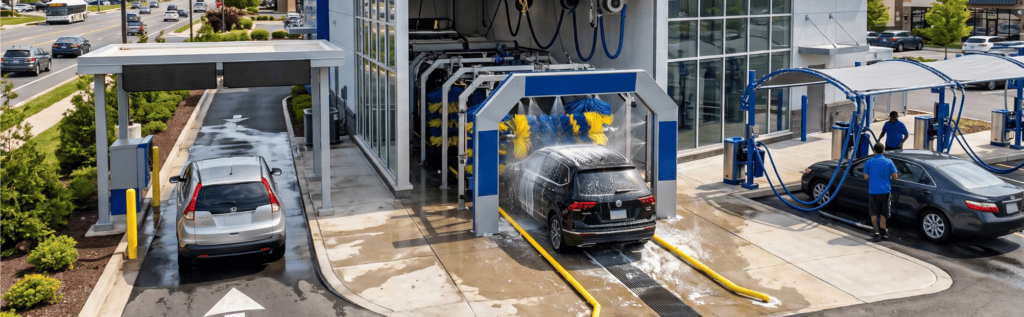
Which Type of Car Wash Is Most Profitable?
You might assume the newest express tunnel with colorful lights and high-tech equipment would be the most profitable.
Not necessarily.
In-bay automatic and self-service washes often have some of the strongest cash-flow margins, ranging from 50–67%. And the reason is pretty simple: labor.
According to Car Wash Advisory, staffing can account for more than 40% of sales at some washes. An unattended wash avoids much of that expense.
Express tunnels, on the other hand, can generate significantly more revenue because they serve more vehicles. Their margins can reach 67%, but they also have higher staffing, equipment and maintenance costs.
Full-service washes can be profitable, too. A location generating more than $1.5 million annually can achieve adjusted cash-flow margins around 48%, compared with approximately 35% for locations earning less than $1 million.
So which model is better?
It depends on what you’re measuring. An unattended wash may keep a higher percentage of every dollar, while a busy express tunnel can generate more total profit because of its volume.
Both can be successful businesses. They just get there differently.
What Does a Real-World Car Wash Profit Margin Look Like?
Industry benchmarks are helpful, but it’s also worth looking at how these numbers play out for an actual operator.
Take Mister Car Wash, the largest car wash chain in the United States.
In the first quarter of 2026, the company reported an adjusted EBITDA margin of 34.8%. In other words, it retained nearly 35 cents of every revenue dollar before certain expenses, including interest, taxes and depreciation.
But its net income margin was considerably lower, at 12.3% across 549 locations.
That’s a pretty big difference.
It shows why strong revenue and healthy cash flow don’t always translate into equally strong bottom-line profits.
Of course, a national chain with hundreds of locations operates differently from an independent car wash. Still, it’s a useful reminder that understanding your expenses is just as important as growing sales.
Source: Mister Car Wash SEC Filing, April 2026
The Big Shift: Memberships Are Driving Growth
Here’s one of the biggest changes happening in the car wash industry:
The wash brings the traffic. The membership brings the recurring revenue.
More operators are relying on unlimited wash clubs to create predictable monthly income instead of depending entirely on individual wash purchases.
And the numbers show why.
According to Rinsed, which analyzes point-of-sale data from more than 3,000 car wash locations, here’s how the industry performed in Q2 2026:
Revenue Stream | Year-Over-Year Change |
Membership revenue | +10.4% |
Retail (non-member) revenue | -3.9% |
Total same-store sales | +5.4% |
Source: Rinsed Quarterly Car Wash Industry Report, Q2 2026, via the International Carwash Association.
And this isn’t a one-quarter trend.
Membership revenue has shown sustained growth for six consecutive quarters. In Q4 2025, it increased 11.3% while retail revenue declined 8.4%.
At Mister Car Wash, unlimited wash club sales represented 76% of total wash sales in Q1 2026, up from 73% a year earlier.
So, do memberships improve car wash profitability?
They certainly create an opportunity. Recurring payments help smooth out seasonal and weather-related fluctuations, making revenue more predictable. But profitability still depends on pricing, how often members use the wash, and what it costs to serve them.
The bigger shift is that operators can no longer focus only on how many cars they wash.
They also need to ask: How many members are we keeping?
The Hidden Cost of Losing Members
Getting someone to sign up for a membership is one thing. Keeping them is another.
In Q2 2026, monthly membership cancellations reached 7.9%, according to Rinsed. Of those, 4.9 percentage points came from customers actively choosing to cancel rather than simply letting a payment method expire.
That’s a significant amount of recurring revenue to replace month after month.
And here’s something operators might not realize: customers aren’t always telling you when they’re unhappy.
The International Carwash Association’s Q2 2026 Pulse Report found a surprising disconnect between what operators expect and how customers actually behave.
- Operators estimated that 53% of dissatisfied customers would return for a rewash.
- Only 17% of consumers said they actually return to give the business another chance.
Think about what that means.
A customer gets a disappointing wash, doesn’t complain, and never comes back. Maybe they cancel their membership. Maybe they start going to the competitor down the street.
Either way, you may never know what went wrong.
That’s why reducing membership cancellations isn’t just about offering competitive pricing. It’s about delivering an experience that makes customers want to stay.
And when you consider how much revenue now comes from memberships, even small improvements in retention can make a meaningful difference.
What Makes Your Wash Worth Choosing Over the One Down the Street?
Competition is changing the way car washes grow.
New express car wash openings dropped from 943 in 2022 to approximately 550 in 2025, largely because many prime locations have already been developed.
At the same time, professional car washing is more popular than ever. Today, 79% of U.S. drivers choose professional car washing, up from 50% in 1996, according to International Carwash Association data cited by IBISWorld.
The U.S. car wash industry is still a substantial business, with IBISWorld estimating approximately $18.7 billion in revenue for 2026. But growth is slowing, and market saturation has become a major concern for operators.
That doesn’t mean car washes aren’t profitable anymore.
It means attracting customers and keeping them is becoming more competitive.
When drivers have several washes to choose from, price and wash quality are only part of the equation.
The overall experience matters, too.
Is the equipment reliable? Is the property clean? Is the visit quick and convenient? Are there extra amenities that make your location a better value?
Sometimes, small additions can make a difference.
For example, offering free tire inflation with an Excel Tire Gauge digital air machine gives customers another useful service while they’re already on your property.
It’s a convenient perk that doesn’t require additional inventory or significant staffing, and it can help make your wash more appealing to both existing members and potential customers.
When two washes offer similar services at similar prices, those extra conveniences can help tip the decision in your favor.
The wash gets them in. The experience keeps them coming back.
How Can Car Wash Operators Improve Profit Margins?
There’s no single change that will instantly make a car wash more profitable. But there are several areas operators can focus on.
Keep more of your existing members.
With monthly cancellations averaging 7.9%, improving retention can have a significant impact on recurring revenue. Pay attention to customer feedback, wash consistency and the overall member experience.
Make membership more valuable.
Give customers reasons to choose your membership over a competitor’s. That might mean faster service, convenient hours, dependable equipment or added amenities like complimentary tire inflation.
Watch your operating costs.
Labor is one of the biggest expenses for attended washes, sometimes exceeding 40% of sales. Efficient staffing, preventive maintenance and reliable equipment can help protect margins.
Focus on the customer experience.
According to the International Carwash Association, nearly 79% of customers would accept a price increase, but their willingness depends heavily on the quality of the experience.
Customers are more likely to see value in a membership when they consistently get what they’re paying for.
And that’s really what ties all of these strategies together.
Improving margins isn’t just about cutting expenses or increasing prices. It’s about giving customers enough value that they continue choosing your wash.
The Bottom Line
Car washes can still be highly profitable in 2026. But with a more competitive market and a growing reliance on membership revenue, the formula for success is changing.
The operators protecting their margins aren’t necessarily the ones washing the most cars. They’re the ones managing costs, keeping members satisfied and finding ways to stand out from the competition.
Sometimes, that means improving wash quality or streamlining operations. Other times, it’s adding small conveniences that make the entire visit more valuable.
Because at the end of the day, the wash brings them in, the membership provides recurring revenue, and the experience determines whether they stay.

