
Ask most operators where their profit comes from and they’ll point to the pumps. The latest numbers tell a different story.
In 2025, U.S. convenience stores sold $341.2 billion in foodservice and merchandise, according to NACS. Those inside sales made up 35% of total store sales but produced 57.4% of gross profit. Fuel, at roughly 65% of sales, delivered 38.8%.
For anyone running a gas station or c-store, that gap is the whole game. Here’s how margins break down by category, and what it means for every square foot you control, inside and out.
The Big Picture: Fuel Brings Volume, the Store Brings Margin
Fuel margins were strong in 2025, averaging over 40 cents per gallon, per NACS Magazine. Before 2020, they ran closer to 22 cents.
But how much do gas stations actually make per gallon of fuel? Gross isn’t net. After card fees, distribution and operating costs, NACS estimates retailers keep roughly 10 to 15 cents a gallon before taxes. Card fees alone hit a record $21.3 billion industry-wide in 2025.
Fuel still matters. More stores sell it than at any point in eight years: 122,620 locations in 2025, and gallons sold rose 0.5% even as the average pump price fell from $3.30 to $3.11.
Fuel’s job is to bring the customer onto the lot. The store’s job is to turn that visit into margin.
And that’s where the numbers get interesting. While merchandise and foodservice accounted for just 35% of average store sales in 2025, they generated 57.4% of gross profit. Fuel, despite representing roughly 65% of sales, contributed only 38.8%.
Costs keep climbing, too. Direct store operating expenses rose 4.2% to just under $166 billion, and the average hourly wage passed $15. Inside transactions fell 1.6%. Basket value rose 24 cents, but basket profitability dropped 8 cents.
Fewer trips, thinner baskets, higher costs: category mix matters more than ever.
What Are C-Store Profit Margins?
Understanding which categories deliver the strongest margins helps operators make better decisions about inventory, promotions, and how they use their space.
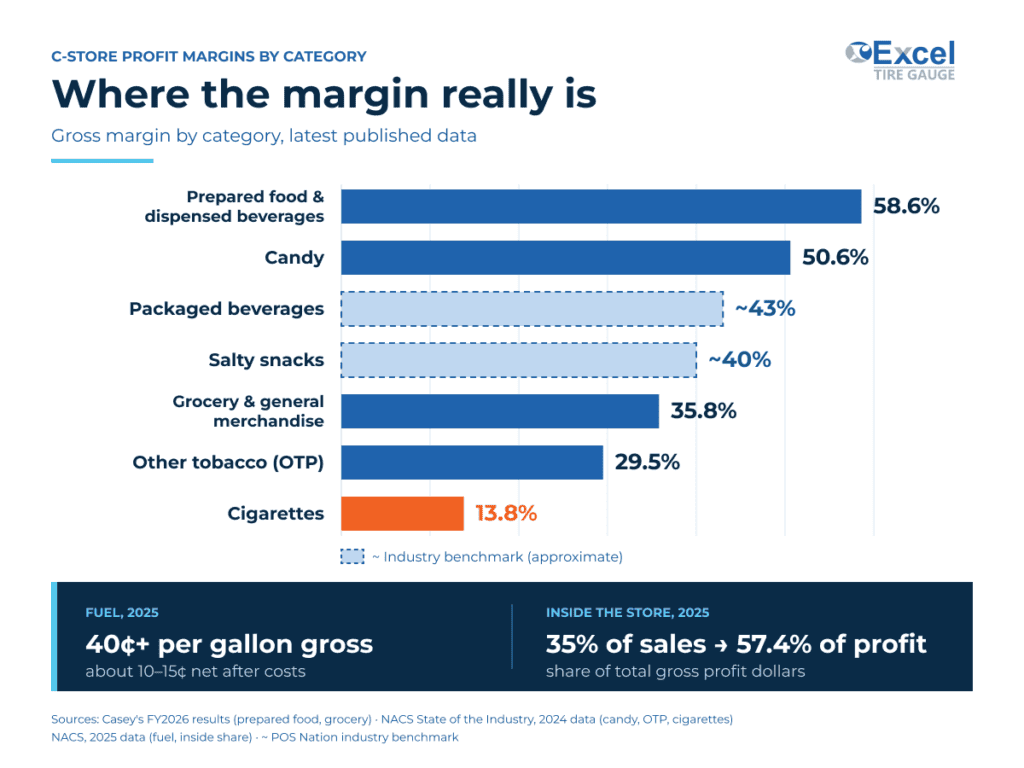
Sources: NACS State of the Industry data (2024–2025), NACS Magazine (2026), Casey’s fiscal 2026 results, and POS Nation industry benchmarks (2026). Figures represent different reporting periods and sources; margins may vary by operator.
So, which convenience store categories actually make the most money? The answer becomes clearer when you look beyond sales volume and focus on gross profit.
Foodservice: The Profit Engine
Prepared food and dispensed beverages lead the pack when it comes to convenience store profitability.
Foodservice accounted for 28.5% of inside sales in 2025 but generated 38.9% of inside gross profit, according to NACS. Top performers do even better: Casey’s, the Midwest chain known for its made-in-store pizza, posted a 58.6% margin on prepared food and dispensed beverages for fiscal 2026.
That makes foodservice one of the most profitable categories in a convenience store, especially for operators who can manage labor and waste effectively.
The catch is execution. Food brings additional labor, spoilage and equipment costs, and NACS reports prepared food sales were nearly flat year over year.
High margin is available, not guaranteed.
Packaged Beverages: The Reliable Traffic Builder
Packaged beverages grew to 18.7% of inside sales in 2025, up 0.8 percentage points. Energy drinks (27.8%) and carbonated soft drinks (26.0%) made up more than half of the category in 2024, per NACS Magazine. Benchmark gross margins sit in the low 40s.
Beer is a different story. Packaged beverages and beer together drive just over 25% of inside sales and gross profit, but more than 80% of that profit comes from packaged beverages.
Beer builds baskets and trips more than it builds margin.
Candy and Salty Snacks: Small Footprint, Big Margins
Candy is only 3.6% of inside sales, yet it earned a 50.58% margin in 2024, per NACS, with average sales of $8,816 per store per month. Salty snacks run near 40%.
These categories demonstrate why smaller products can have an outsized impact on profitability. They require relatively little shelf space, appeal to impulse buyers and offer stronger margins than many traditional convenience store staples.
The shelf keeps moving, too. In 2025, 435 new candy and salty snack items entered the channel, and alternative snacks grew 7.9%.
Tobacco: The Category in Transition
Cigarettes have long been a major convenience store category, but their share of inside sales is shrinking.
According to NACS, cigarettes fell from 30.9% of inside sales in 2015 to 18.8% in 2024.
Why are cigarette profit margins so low? Excise taxes and manufacturer pricing leave retailers with relatively little room. Cigarettes earned a 13.76% gross margin in 2024, compared with 29.50% for other tobacco products (OTP).
Nicotine pouches are helping reshape that category. As part of OTP, they benefit from a category gross margin roughly double that of cigarettes. In 2025, OTP surpassed cigarettes in gross profit per store per month for the first time, led by nicotine pouches.
That doesn’t necessarily mean every nicotine pouch product is twice as profitable as cigarettes, but it does signal a meaningful shift in where tobacco-related profit is coming from.
For operators, that means rethinking the backbar. A growing source of tobacco-category profit now takes up far less space than a wall of cartons.
What Does This Mean for Convenience Store Profitability?
Knowing which categories have the highest margins is useful. Putting that information to work is what improves profitability.
Manage by gross profit dollars, not sales.
A dollar of candy earns more than three and a half times what a dollar of cigarettes does in gross profit. Put simply, $10 of candy returns about $5.06 in gross profit, while $10 of cigarettes returns about $1.38.
Space, labor and promotions should follow the profit, not just the register total.
Protect the trip.
Every inside category depends on getting drivers from the pump into the store, and inside transactions are already falling.
Anything that adds a reason to stop, or encourages a customer to walk inside, supports the whole model.
Look beyond the four walls.
The store isn’t the only place to generate revenue. Forecourt services such as car washes, vacuums and tire air can create additional revenue opportunities without the inventory demands of traditional merchandise categories.
And unlike many inside categories, automated services can generate revenue around the clock with minimal direct staffing.
Where Tire Air Fits
A pay air machine offers some of the same advantages as a high-margin convenience store category, without the traditional inventory requirements.
There’s no product to stock, no spoilage and no one needed to staff each transaction. With a card reader, the machine can generate revenue 24/7.
No budget for an air machine? Through the Excel Tire Gauge Revenue Share Program, eligible stations can have a pay air machine installed, maintained, and serviced with no upfront equipment cost. Excel handles collections, provides a dashboard showing machine transactions and issues revenue-share payments quarterly.
For operators focused on profitability, it’s another way to put their forecourt to work without adding inventory or significant day-to-day labor.
But the opportunity goes beyond the machine itself.
With the Excel Tire Gauge SC05-SS Kiosk Hybrid Air Machine, stores can issue free air codes inside. A driver who might otherwise stop for air and leave now has a reason to enter the store, where foodservice, beverages and snacks offer some of the strongest margins.
A simple forecourt service becomes another opportunity to increase inside traffic.
The Bottom Line
Convenience store profit margins tell a clear story: fuel brings customers to the property, but much of the gross profit comes from what happens beyond the pumps.
Foodservice, beverages and snacks continue to offer strong opportunities, while changing consumer habits are reshaping traditional categories like tobacco.
For operators, the goal isn’t simply to sell more. It’s to make every customer visit, every square foot and every available service work harder.
Margins inside the store are shifting fast. The forecourt is still an open opportunity.

